
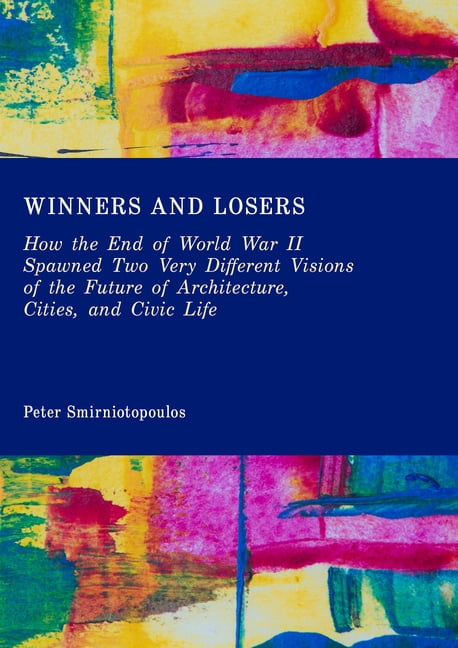
Winners and Losers: How the End of World War II Spawned Two Very Different Visions of the Future of Architecture, Cities, (Hardcover)
Product details
| Management number | 240511804 | Release Date | 2026/07/16 | List Price | US$47.58 | Model Number | 240511804 | ||
|---|---|---|---|---|---|---|---|---|---|
| Category | |||||||||
The bombing of Hiroshima and Nagasaki over 80 years ago led to the surrender of Japan and, shortly thereafter, the end of World War II, and ushered in the Atomic Age. The response to these apocalyptic events, unsurprisingly, gave rise to diametrically opposed reactions between the "losers," Japan in particular, and the "winners," specifically the United States. This book examines the origins of and historical contexts for the advent of Japanese Metabolism and Googie architecture, respectively, and explores how each "movement" impacted their contemporary contexts, the evolution of the works of their most-ardent advocates and adherents, and the future of cities and the blossoming post-World War II suburbs in the US. In post-WWII Japan, architects, designers, urban planners, philosophers, and science fiction writers coalesced around Japanese Metabolism at the World's Exposition Osaka, 1970, ten years after the publication in 1960 of the Metabolist Manifesto in 1960 by a handful of Japanese architects. At its most-exuberant, Futurism--an offshoot of the Modern Movement in contemporary architecture--was expressed through "Googie architecture," first introduced and popularized in the greater Los Angeles area but soon thereafter filtering out to the rest of America, as the entire country fully embraced the ascendance and ultimate dominance of the personal automobile. This book traces and analyses the historical evolution of Japan and the United States, leading up to and through World War II, addressing the emergence of each "movement" and how they impacted the architecture, urban planning, and cultural evolution in and of each country and their respective impacts on contemporary life. It will conclude by considering the fate of oppressed and defeated peoples and how they might imagine, envision, and implement a new future.
- Winners and Losers: How the End of World War II Spawned Two Very Different Visions of the Future of Architecture, Cities, (Hardcover)
- Author: Ethics International Press, Inc
- ISBN: 9781837116973
- Format: Hardcover
- Publication Date: 2026-11-15
- Page Count: 345
| Book format | Hardcover |
|---|---|
| Fiction/nonfiction | Non-Fiction |
| Genre | Art, Music, and Photography |
| Publication date | November, 2026 |
| Pages | 345 |
| Subgenre | History |
| Series title | No Series |
| Number in series | 0 |
| Edition | 1 |
| Publisher | Ethics International Press, Inc |
| Language | English |
| Is collectible | N |
| Binding type | Case Binding |
| Recording time | 0 min |
| Retail packaging | Single Piece |
| Assembled product dimensions (l x w x h) | 6.00 x 0.90 x 8.00 in |
| Assembled product weight | 1.25 lb |
| Bisac subject heading | Architecture |
Bestseller ranking
21st Century Modern History Books




Customers who viewed this product also viewed
Vessel Sinks





Correction of product information
If you notice any omissions or errors in the product information on this page, please use the correction request form below.
Correction Request Form